When we imagine global citizenship, our minds often travel far beyond our immediate surroundings, to other countries, cultures, and continents. This year, the Global Citizenship Program (GCP) invited students to begin somewhere closer to home. By deepening our engagement with St. Louis, we explored how global citizenship is not only an abstract ideal or something practiced abroad, but a way of being rooted, attentive, and responsible within our local community.
Throughout the first semester, students in the Geographies of Globalization course grappled with complex global forces. We dived into neoliberalism, immigration, carcerality and surveillance, and extractive industries. As these concepts came into focus, students were also asked to turn inward and reflect: How do our own stories, identities, and positionalities shape the ways we move through a globalized world? And how do these large scale systems take form in the places we live every day?
Those questions came alive through shared experiences beyond the classroom. Two key excursions offered students the opportunity to sit with the layered histories of the region, histories marked by violence and dispossession, but also by resilience, care, and community. With the support of the Gephardt Institute, we visited Cahokia Mounds alongside Galen Gritts, learning about the deep Indigenous presence on this land and the enduring impacts of colonization. Students were invited to reckon with St. Louis’s role in the displacement and genocide of Indigenous peoples and to consider what it means to study and live on this land today.
We also visited East St. Louis and The Ville. In East St. Louis, students visited East Side Heart & Home Family Center, where they met neighbors who shared stories of growing up, staying, and building community amid systemic neglect. In The Ville, Aaron Williams of 4TheVille guided us through a neighborhood shaped by Black excellence, cultural leadership, and collective resistance, while also naming the ongoing effects of disinvestment and structural racism. These visits challenged students to hold complexity and to grapple with both harm and hope, past and present, side by side.
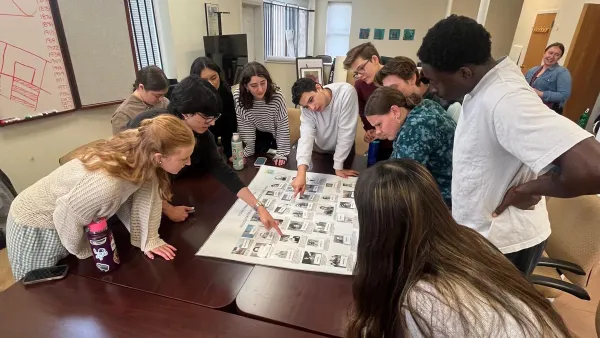
Back in the classroom, these experiences were deepened through conversations with local educators, organizers, and practitioners. Guests included Eric Pinto from the Kathryn M. Buder Center; Jonah EagleFeather, a Lakota social work student; Chels Fabian and Savanna Sowell from WashU’s Prison Education Project; and Gabby Eisner and Valencia Álvarez from the MICA project and Migrantes Unidos.
Together, these encounters helped students understand how systems of incarceration, education, and immigration take shape in our local context. The semester also included a visit from Zia Kandler, a consultant specializing in holistic and community based security, who invited students to think differently about safety, care, and collective responsibility in times of heightened risk for activists and change makers.
What emerged over the course of the semester was not just new knowledge, but a learning community. Students learned from the places we visited, from the people who shared their stories, and from one another. Together, we practiced listening, reflection, and accountability during a time marked by uncertainty and challenge at local, national, and global levels.
As we look ahead to the next semester, we are excited to continue this work. To deepen our relationship with St. Louis and to keep asking what it means to live global citizenship, not as an abstract concept, but as a daily, grounded practice.